the illustrator of Dr. Stone He published a series of messages that are turning around the world of manga — and not because he attacks anyone, but because he defends those who all attack. According to Boichi, people who read manga at pirate sites are not criminals or enemies of the industry: they are an unsatisfied demand hoping someone will offer you a real alternative. It is one of the most honest positions that an artist of his level has made public in years.
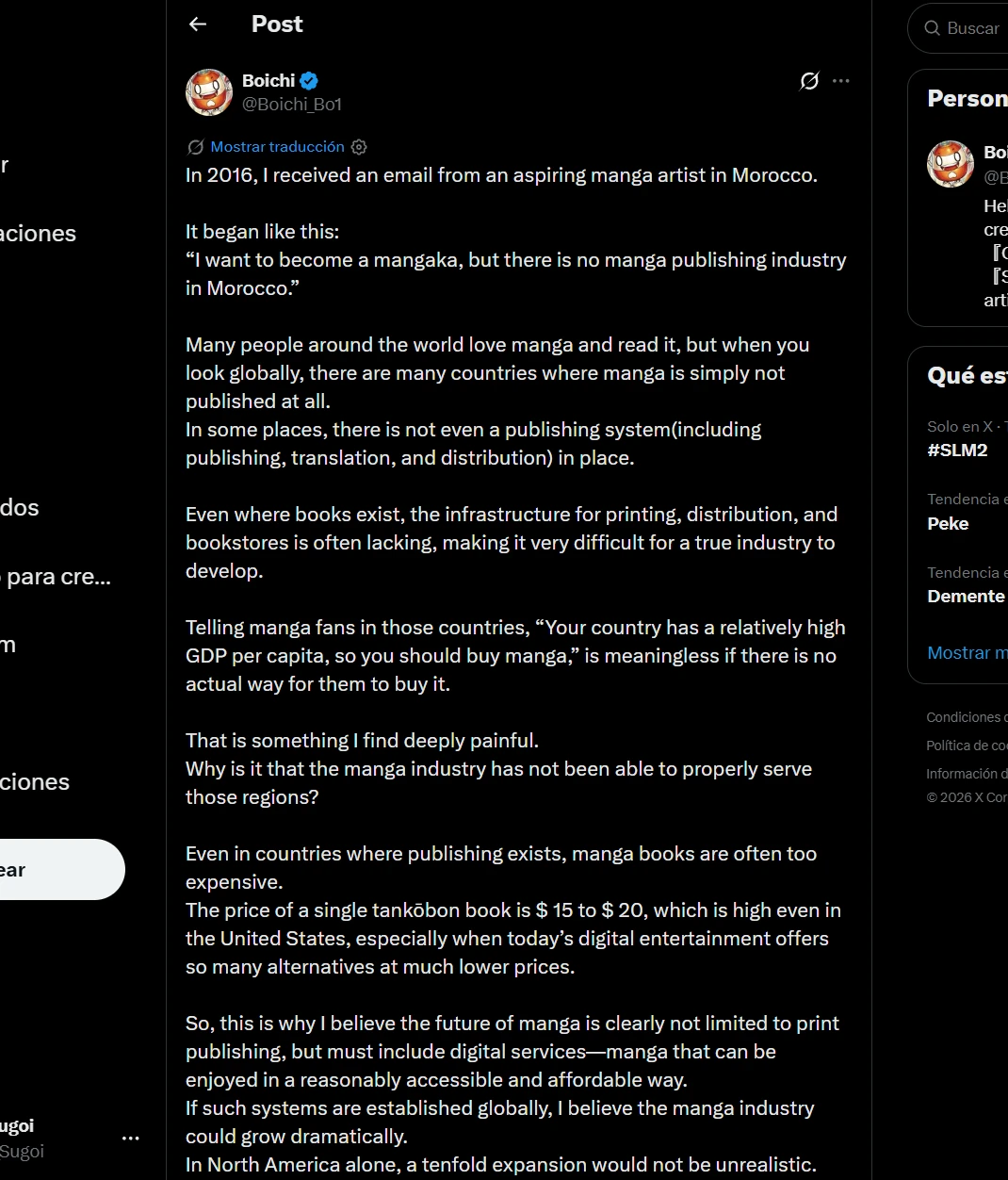
What Boichi said and why it matters
Through an extensive series of social media posts, Boichi, known globally for being the illustrator of Dr. Stone and author of works such as Sun-Ken Rock and origin, addressed one of the most uncomfortable topics in the Japanese entertainment industry: manga piracy.
What is striking is not that he has talked about it. It’s the address from which he did it.
Instead of joining the usual discourse that treats readers of unauthorized sites as thieves or as an existential threat to creators, Boichi He proposed something different: seeing those people as potential clients of an industry that has not yet reached them in the right way.
‘Not all countries have the same laws’
One of the first points that the artist addressed is something that is rarely discussed outside legal circles: the legality of reading pirate manga is not the same in all countries.
Boichi, illustrator of Dr. Stone, explained that depending on the national legislation and the international agreements of each country, the legal situation can vary significantly. In some places, downloading or reading unauthorized material has implications other than those assumed from the perspective of Japanese or American law.
That said, the artist was clear in his ethical position: regardless of what the law of each country says, the unauthorized distribution of other people’s creative work is a serious problem that directly affects creators.

The real enemy is not the reader
Perhaps the most resonant point of his entire intervention was the distinction that Boichi He traced among the individual readers and the organizations that operate behind the great piracy sites.
According to the illustrator, the reality of the pirate ecosystem changed radically with respect to the era of fan groups that made unofficial translations for the love of manga. Today, many of the busiest piracy sites function as international companies that generate millionaire income through advertising and other forms of monetization, without paying a penny to the creators whose work they exploit.
To Boichi, illustrator of Dr. Stone, that is where the real combat should be concentrated: not in pursuing the reader who does not have access to an accessible legal alternative in his country, but on organizations that systematically profit from the work of others.
The solution you propose: Make the legal manga the obvious option
Boichi’s proposal is as simple as it is difficult to implement: creating the conditions so that buying manga legally is easier, cheaper and more convenient than hacking it.
The artist points out that in many countries of the world, including much of Latin America and Southeast Asia, there is no basic infrastructure to consume manga legally: there are no local publishers, there is no adequate physical distribution, there are no affordable digital services in the local language. In this context, asking a reader to ‘buy the official manga’ is an instruction that simply cannot be fulfilled.
the logic that Boichi It proposes is the reverse to which the industry usually apply: instead of trying to eliminate the existing demand through blockades and legal persecution, satisfying that demand with a real offer. When a country develops its own comic and manga industry, with publishers, digital services, distribution and affordable prices, it creates an ecosystem where governments collect taxes, local artists find opportunities, and readers have a specific reason to choose what is official about pirates.
The example of South Korea that changed everything
To sustain your argument, Boichi, illustrator of Dr. Stone, does not speak in the abstract. He speaks from his experience: he grew up and trained as an artist in South Korea, a country where comic piracy and manhwa was extremely common two decades ago.
what happened in South Korea When Webtoon legal platforms came up accessible, with reasonable prices and content in the local language, it was exactly what Boichi It proposes to replicate globally: a large part of the readers who previously consumed pirate content naturally migrated to the official platforms. Not because they will force them. Because the legal alternative was good.
This process not only formalized consumption, it transformed South Korea In one of the world’s strongest digital comic industries, with platforms like webtoon that today have global audiences of tens of millions of users.
A surprisingly optimistic message
What makes Boichi’s position different from most piracy speeches is tone. There is no condemnation, there is no threat, there is no victimization. There is a diagnosis and a proposal.
The reader who today consumes manga in an unauthorized site, according to the illustrator, is not an enemy of the creators, is someone who has already shown that he wants the product. That is exactly the opposite of a person who is not interested in the manga. And a person who wants the product, but cannot access it legally, is the first natural client of any official platform that reaches its market with the correct proposal.
For Boichi, the satisfaction of directly supporting the creators you love is genuinely older than consuming free. The problem is not the disposition of the reader, it is the absence of the offer.