

The mangaka Japanese Nishizawa 5mm It has recently captured the attention of users on social networks and digital media thanks to an illustration that addresses, with humor and precision, a universal doubt “How do you know if a girl likes you?“. His answer is presented in a four-vignette manga that has been widely shared by his clear and direct way of representing something as subtle as affective language.
The publication went viral especially among young readers and followers of the manga for its ability to synthesize, in just four paintings, different ways of interpreting the same praise depending on the tone, context and body expression.
This is how you will know if a girl likes you (according to a manga author)
in his sleeve, Nishizawa 5mm presents to Four girls Using a “cute” expression to refer to the same character, but with very different meanings. The contrast is not in the word used, but in non-verbal, corporal language, and in the labels that accompany each vignette.
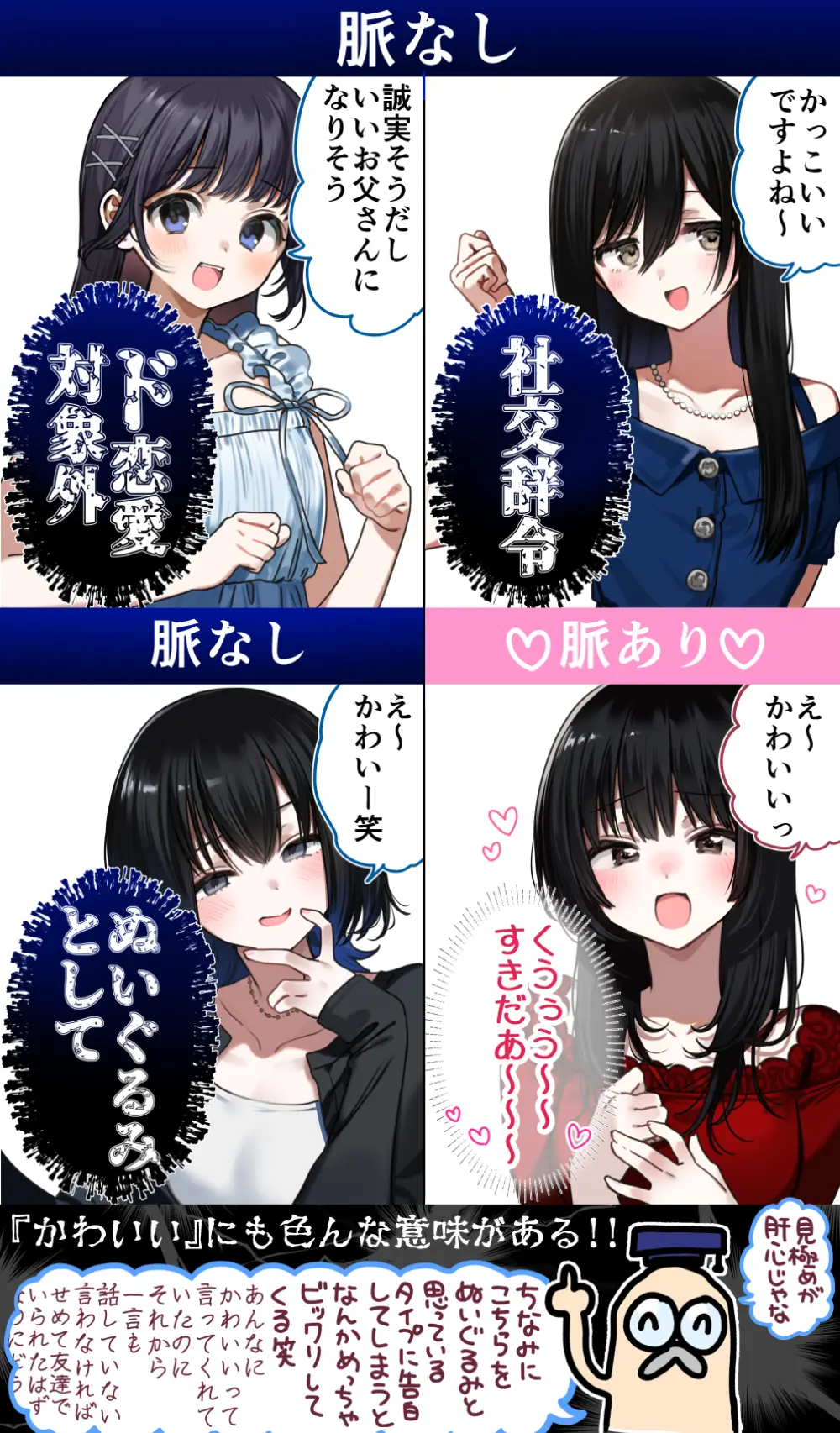
first case (Upper left corner): Out of all romantic possibility
phrase: “He looks like a sincere person… I think he would be a good father.”
Tag: ド恋愛対象外 (totally outside the romantic zone)
This praise, although it seems positive, is a clear example of unattractive admiration. The girl sees the interlocutor as someone reliable or “husband material” in the most abstract sense, but without any emotional implication. It represents a platonic assessment, closer to sympathy or trust than to romantic desire.
second case (top right corner): simple social courtesy
phrase: “It has quite a style, right?”
Tag: 社交辞令 (Educated social comment)
Here, the praise fulfills a label function. It is a polite way of having a conversation or not looking impolite. It does not imply any interest; It is simply a neutral gesture that usually occurs in work or formal environments, and that should not be misunderstood as an affective signal.

Third case (bottom left): Tenderness without attraction
phrase: “Eeeh, how cute hahaha”
Tag: ぬいぐるみとして (like a stuffed animal)
This scenario is quite common among friends or acquaintances. The “cute” here refers to an adorable look, like you’re a pet or a stuffed animal. The girl finds the adorable interlocutor, but devoid of romantic connotations. Tenderness is valued, but the subject is not associated with a possible partner.
fourth case (bottom right): Obvious attraction
phrase: “Aaaah, how cute! Aaaah, I like you a lot!”
No label, but with obvious emotional expression
This is the only situation where the praise is clearly loaded with emotion and attraction. The exaggerated expression, the drawn hearts and the verbal spontaneity are unequivocal signs of genuine romantic interest. It is the only one of the four examples in which the girl openly shows that she feels something beyond friendship or respect.
Can praise really indicate someone’s interest?

Mangaka herself has pointed out that Interpreting a person’s feelings only through language can be complicated, especially in cultures like the Japanese, where courtesy of direct emotional honesty is often prioritized. However, his illustration works as a funny guide that highlights the importance of context, intonation and non-verbal gestures when trying to understand another person’s feelings. The manga and the example of a girl highlight these nuances.
Public reactions and reflections
The publication has generated a wave of comments, both of those who feel identified with the confusions that it raises, and of those who have experienced similar situations. Some highlights reflect the frustration and resignation of years of misunderstanding:
“According to my wife and daughter: if the woman doesn’t ask you, there’s no chance.”
“The experience of making the two most serious mistakes and being defeated makes us stronger.”
“When a woman calls you cute, it doesn’t really mean anything. Accept the compliment and keep going.”
The girl and the virality of this illustration is due, in large part, to the fact that it poses a daily situation with an accessible tone, understandable both for those who consume manga and for those who are simply interested in human relations and interpersonal communication.
The value of emotional interpretation
Beyond humor, the work of Nishizawa 5mm It puts an important question on the table: Emotional language is not always direct, and can often be wrapped in ambiguity. Understanding others requires attention to detail, observation and, on many occasions, intuition.
In the real world, unlike the manga, people don’t always express what they feel clearly. But examples such as a situation with a girl serve to reflect on how we read the signs of the other and how we interpret everyday gestures correctly or not.